Table of Contents
- What Is the Downside of a Dental Bridge?
- The Basics of Dental Bridges and Their Drawbacks
- A Closer Look at Bridge Disadvantages and Risks
- Maintaining Your Dental Bridge: Cleaning and Care Strategies
- Long-Term Considerations for Bridge Wearers
- Common Questions About Dental Bridges
- Your Smile, Your Decision: Navigating Bridge Treatment
What Is the Downside of a Dental Bridge?
You may be wondering what the downside of a dental bridge is. While bridges are a common and effective restoration, they come with meaningful trade-offs. The most significant drawbacks are the loss of jawbone stimulation, the permanent alteration of adjacent healthy teeth, and the potential to complicate future implant placement.
The problem is that dental bridges do not stimulate the jaw-bone like roots would. Since they sit on top of the gums instead of going into them, the body might think there’s no reason for any bone to be present under them anymore, which results in some of it being resorbed. This ongoing process of bone loss over time can alter your facial shape, contributing to a sunken appearance around the mouth and cheeks.
Should you want to replace a bridge with a dental implant at some future time, if bone density has decreased as a result of tooth loss, your dentist might need to perform a bone graft to sufficiently increase bone mass in order to support an implant.
In order for a normal bridge to work, the two surrounding teeth need to be shaved down somewhat to give that bridge something to anchor on. It differs from an implant in that the implant itself does not alter any of its neighbors, whereas a bridge requires this irreversible preparation before it will sit properly.
The disadvantages include bone loss, tooth reduction, and the potential need for future grafting, and these are important points to discuss with your dentist. That said, there are cases that a bridge can be the answer to a quick fix for a missing tooth without involving surgery.
Key Takeaways
- Dental bridges replace missing teeth by filling the space between two real teeth using a fake tooth.
- If you are asking what is the downside of a dental bridge, understanding these key risks can help you make a fully informed decision.
- Dental bridges might have some dangers but these could be averted by having cleanings done frequently.
- Although dental bridges can be used immediately, patients should pay attention to the impact these procedures will have on their jaw bone and surrounding teeth.
- They are a fairly common choice among dental patients in New Westminster, but there are some disadvantages people would like to know before making their decision.
The Basics of Dental Bridges and Their Drawbacks
Dental bridges replace missing teeth by filling the space between two real teeth using a fake tooth. Although they can restore function and appearance effectively, preparing the neighbouring teeth is one of the most significant drawbacks of dental bridges, because it permanently alters healthy tooth structure that will never grow back.
The replacement tooth—called a pontic—is fused to a crown on each side, and those crowns are cemented onto the reshaped anchor teeth. This creates a single, stable unit that restores chewing ability and prevents the remaining teeth from drifting out of position. The procedure typically requires two visits: the first appointment involves reshaping the abutment teeth and taking impressions, while the second appointment delivers and cements the finished bridge.
This preparation is permanent. The enamel, which acts as a natural protective covering for teeth, has been stripped away and the underlying parts are now more susceptible to tooth decay due to exposure at the junction where the crown touches the tooth. Caries formation and periodontal disease are named as two of the main biological problems causing loss of abutment teeth that are used with tooth-supported fixed prosthetic restorations according to research cited by the ADA. Once bacteria reach this junction, decay can advance rapidly underneath the crown, without being noticed until the tooth decays itself.
An advanced form of periodontal disease, which destroys bone and soft tissues surrounding the supporting teeth, was shown to be more likely to cause failure of the abutments compared with technical causes, such as chipping. Having a fixed bridge means that flossing underneath a pontic is harder because the bridge takes up space where floss would go and needs special tools and daily dedication.
At Diamond Dental Centre, we emphasize that the long-term success of a bridge depends heavily on a patient’s commitment to oral hygiene and regular dental check-ups. Without structured maintenance, even a well-made bridge can fail prematurely. We offer a judgement free space to discuss these practical realities, because we believe informed patients make the best decisions about their oral health.
Beyond the biological risks, bridges have the inherent limitation of being temporary restorations. We explain this in our patient education resources: dental bridges typically last between five and fifteen years with proper care, compared to implants that can function for several decades. The cement bond can weaken over time, the underlying tooth structure can develop new problems, and the bridge may eventually need to be recemented or replaced entirely. Understanding these basic limitations prepares us for a closer look at the specific disadvantages and long-term considerations every patient should weigh before moving forward.
A Closer Look at Bridge Disadvantages and Risks
If you are asking what is the downside of a dental bridge, understanding these key risks can help you make a fully informed decision.
| Aspect | Dental Bridge | Dental Implant |
|---|---|---|
| Bone health | Causes gradual jawbone resorption because it lacks root stimulation | Preserves bone through osseointegration |
| Impact on adjacent teeth | Requires irreversible reshaping of healthy neighbouring teeth to support crowns | Does not require alteration of adjacent teeth |
| Lifespan | Typically 5–15 years before replacement is needed | Often lasts decades or a lifetime |
| Hygiene difficulty | Cleaning under the pontic and around crowns is more demanding, which elevates biological complication risk | Cleans more like a natural tooth |
| Primary complication risk | Biological issues such as decay and gum disease are the leading cause of abutment failure | Biological risks are generally lower when well maintained |
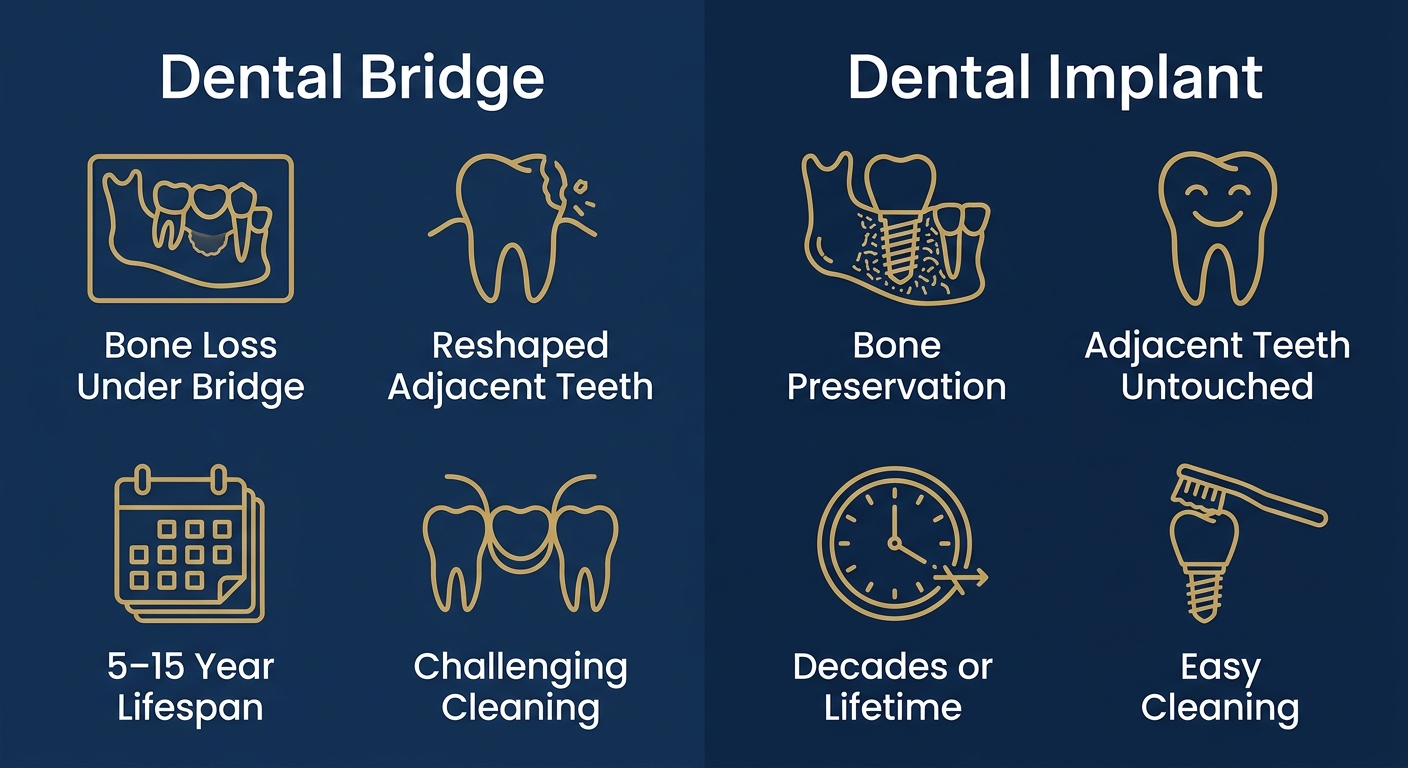
There are several things that make up all the downsides of a dental bridge. We’ll be looking closely at five major factors here.
Bone Loss and Its Effects
The root isn’t replaced, so the jawbone still lacks stimulation, as when a pontic replaces the visible crown of a tooth whose root has been removed. Therefore, should this patient decide to change to dental implants then their mouth might need to be prepared first by having bone grafts done. Conversely, dental implants are able to join directly with the bone and so stimulate the ridge and help keep a face looking fuller.
Impact on Adjacent Teeth
To get anchoring for a bridge, surrounding teeth need to have their sides reduced and be shaped down so the crowns can sit on top of them. This implies removing a part of normal enamel, which can’t be replaced once done. The method with dental implants differs from this technique in that they stand by themselves and don’t modify any neighboring teeth whatsoever.
Challenges with Cleaning and Flossing
A special dental floss threader must be used to guide floss under the pontic. The small space beneath the pontic is a hiding place for food debris and bacteria that routine brushing alone rarely reaches.
Increased Risk of Decay and Gum Disease
The abutment teeth are subject to more caries due to plaque persistently settling underneath the pontics, as well as periodontal pockets surrounding the crowns. A report from the ADA states that caries and periodontitis are two major biological reasons associated with abutment loss for fixed dental bridges supported by teeth. Maintenance is essential for anyone with a bridge and should be structured, including professional cleanings and careful at-home oral care.
Expected Lifespan and Replacement Needs
A well-made 3-unit bridge commonly serves for 5 to 15 years, as detailed in our own FAQ materials. By comparison, dental implants frequently reach 20 to 30 years or more, with some lasting a lifetime when properly maintained. Once a bridge’s supporting tooth structure is compromised or the restoration itself fractures, repair is seldom an option because the individual components are fused together. Because many of these risks are linked to daily hygiene, proper cleaning is essential—we’ll explore the best care techniques next.
Maintaining Your Dental Bridge: Cleaning and Care Strategies
Dental bridges might have some dangers but these could be averted by having cleanings done frequently. Here at New Westminster, BC, our crew guides patients through every step of bridge care to safeguard the supporting teeth and gums.
Effective Oral Hygiene Techniques for Bridge Care
About 45 cm of dental floss should be threaded through the eye of the threader. Then pull the floss with the stiff tip up under the pontic, coming from the cheek towards the tongue. Wrap the floss around an abutment crown in a C shape. Make sure to pull the floss up and down along the tooth surface as well as below the gumline. After that, repeat these steps on the other abutment crown, moving back and forth. Do these once daily to prevent decay at the margins of the crowns.
Tools and Products for Cleaning Around a Bridge
Interdental brushes with a tiny cone-shaped head will assist in cleaning the larger spaces between the abutment teeth and underneath bridges. Water flossers utilize a stream of pulsating water to flush food particles and plaque from under the pontic and along the gumline.
| Tool/Method | Description | Effectiveness | Usage Recommendation |
|---|---|---|---|
| Floss threader | A stiff plastic threader that guides regular floss under the pontic | Excellent for threading floss under the pontic | Use daily as part of evening routine |
| Interdental brush | Small bristle brush in various sizes to clean between teeth and under the bridge | Very effective for larger gaps around abutment teeth | Use daily or as directed after meals |
| Water flosser | Device using a stream of pulsating water to flush debris | Good for flushing debris and massaging gums, especially for difficult-to-reach areas | Use as a supplement to flossing, particularly if dexterity is limited |
| Super floss | Pre-cut floss with stiff end and spongy segment | Very good for threading under pontic without needing a separate threader | Ideal for travel or quick cleaning |
| Soft-bristle toothbrush | Standard manual or electric brush for cleaning crown surfaces | Essential for brushing all crown surfaces; not effective under the pontic | Use twice daily with fluoride toothpaste |
Professional Maintenance and Check-up Schedule
Patients should have their bridge checked at least once every three to six months when they come into our clinic for a cleaning and examination of both bridge and supporting teeth. This way we can look for the first sign of tooth decay, periodontal inflammation, and loosening of the bridge itself. Biological complications like caries and periodontitis are often responsible for abutment loss from a fixed bridge. Structured care of the bridge and periodontium can help prevent this. Using special instruments, our hygienist will clean difficult places under and around the bridge. If you stay up to date with regular checkups, you stand the best chance of keeping your bridge for many years without any problems.
Comparing Maintenance: Bridge vs. Implant Hygiene
It requires more attentiveness on a day-to-day basis as far as taking care of the abutments on a bridge compared to an implant because if one doesn’t brush one’s teeth properly, or if one doesn’t floss between them, then there’s a possibility that cavities might appear where the teeth meet up with each other at their tips. It’s also true for implants that although one may think about it to be something that would not need any care whatsoever but in truth, yes, one has got to brush properly, clean well all around the post and not let peri-implantitis set in which causes bone destruction.
A good way to make sure that your bridge works as long as possible is setting up a solid maintenance plan at present time.
Long-Term Considerations for Bridge Wearers
Although dental bridges can be used immediately, patients should pay attention to the impact these procedures will have on their jaw bone and surrounding teeth. Understanding these factors helps you make a confident, informed decision about your oral health.
Dental bridges rest on your gums and do not replicate the root structure of a natural tooth. Without that stimulation, your jawbone may begin to resorb. This is a process that can gradually change facial contours and create a sunken appearance over several years. Diamond Dental Centre in New Westminster frequently talks to patients about how long-term bone resorption due to missing teeth might affect those wishing to switch to dental implants at some point in the future. If significant resorption has occurred, a bone graft becomes necessary to rebuild the site before an implant can be placed successfully.
Firstly, we make sure patients know that when getting a traditional bridge placed, it typically involves reshaping the neighboring teeth to serve as anchors. These alterations cannot be reversed. With a dental implant, though, there’s nothing to alter on adjacent healthy teeth. What we try to convey during this meeting is that we value a gentle, judgment-free conversation about these choices so you can weigh the long-term implications without pressure.
Patients often ask what is the lifespan of a dental bridge. Generally speaking, a three unit bridge can be used comfortably between five to fifteen years with adequate care, whereas a dental implant could potentially serve up to twenty to thirty plus years, if taken care of properly. Because a bridge has a finite lifespan, we recommend planning for eventual replacement, a consideration that does not apply to the more permanent implant solution.
If you want your implant to help maintain your bone health in the long term, then dental implants are fused with your jawbones via osseointegration and they will keep their bone density and structural shape. That means there won’t be any need to change out bridges in the future and they can protect adjacent teeth without changing them at all. There are a couple of other questions you may have as a result of these benefits.
Common Questions About Dental Bridges
They are a fairly common choice among dental patients in New Westminster, but there are some disadvantages people would like to know before making their decision.
What are the main disadvantages of a dental bridge?
A bridge requires reshaping adjacent healthy teeth permanently to support crowns. It also does not stimulate the jawbone, so bone loss can occur under the gap. A bridge lasts 5–15 years compared to decades for implants.
Why do bridges fail?
Biological complications such as cavities and gum disease are the leading cause of bridge failure, according to long-term research reported by the American Dental Association. This makes ongoing oral hygiene critical.
How can I improve a bridge’s longevity?
Consistent daily brushing and flossing, along with regular dental exams in New Westminster, help prevent decay around the bridge and keep abutment teeth healthy. Regular check-ups allow us to catch early problems.
FAQ based on the article
How often do dental bridges need to be repaired or replaced?
Dental bridges typically need replacement every 5 to 15 years. The cement bond can weaken, and the underlying tooth structure may develop new problems over time. Unlike implants that can last decades, a bridge is a temporary restoration that will eventually require recementing or complete replacement.
Do dental bridges prevent bone loss in the jaw like dental implants do?
No, dental bridges do not prevent bone loss like dental implants do. Without a root structure to stimulate the jawbone, gradual bone resorption occurs under the bridge. This can change facial contours over time and may complicate future implant placement, sometimes requiring a bone graft.
Is it difficult to clean and floss around a dental bridge?
Yes, cleaning and flossing around a dental bridge is more demanding. The space under the pontic traps debris and bacteria, requiring special tools such as floss threaders or interdental brushes. Daily dedication is essential, as routine brushing alone rarely reaches these areas effectively.
Can Dental Bridges Increase the Risk of Tooth Decay or Gum Disease?
Yes, dental bridges can increase the risk of tooth decay and gum disease. The abutment teeth are more susceptible to caries at the junction where crowns meet reshaped enamel, and periodontal pockets can form around the crowns. Biological complications like these are leading causes of abutment tooth loss.
Does Getting a Dental Bridge Require Filing down Healthy Adjacent Teeth?
Yes, getting a dental bridge requires filing down the healthy adjacent teeth to serve as anchors for the crowns. This permanent reshaping removes protective enamel, which does not grow back, and makes the abutment teeth more vulnerable to decay at the margins where the crown and tooth meet.
Your Smile, Your Decision: Navigating Bridge Treatment
Choosing between a dental bridge and a dental implant comes down to how each affects natural teeth and health. A bridge requires reshaping healthy adjacent teeth for support, while an implant preserves neighboring structure and helps maintain bone density. Implants boast a success rate above 95% and last decades. Because your oral health, bone density, and goals are personal, we encourage you to consult our team. Understanding what the downside of a dental bridge is clarifies your options; your smile, your decision: contact us to book a consultation.
Get Personalized Bridge Advice
Now that you understand the potential downsides of dental bridges—from jawbone loss to the permanent reshaping of healthy teeth—you may be weighing your tooth replacement options. The information you’ve explored highlights that bridges, while common, require careful consideration and diligent maintenance. At Diamond Dental Centre in New Westminster, BC, we focus on patient education so you can make the best decision for your long-term oral health. Whether you’re leaning toward a bridge or an implant, our team can assess your specific needs and bone density. We’ll discuss how each option fits your smile goals and what to expect in terms of care and longevity. Reach out to schedule a consultation and take the next step toward a confident, healthy smile.
Get Personalized Bridge Advice