Table of Contents
- Recognizing Tooth Abscess Symptoms and Seeking Treatment in New Westminster
- What Is a Tooth Abscess and How Does It Develop?
- The Progression of a Tooth Infection Without Treatment
- Immediate Steps and Treatment Options for a Tooth Abscess
- When Tooth Extraction Becomes Necessary for a Severe Abscess
- Common Questions About Tooth Abscesses Answered
- Protecting Your Smile: Expert Dental Care in New Westminster
Recognizing Tooth Abscess Symptoms and Seeking Treatment in New Westminster
Once you recognize the warning signs of a tooth abscess, it is critical to understand the symptoms and treatment options available in New Westminster. Common symptoms include:
- A persistent, throbbing toothache
- Sensitivity to hot or cold temperatures
- Swelling in the face or cheek
- Tender, swollen lymph nodes under the jaw
- Fever
- A foul taste or odor in the mouth
Recognizing tooth abscess symptoms and treatment urgency is vital, as the infection can advance through several stages of tooth infection if not addressed promptly. A tooth abscess is a dental emergency; left untreated, the infection can spread to the jaw, neck, or bloodstream, resulting in severe health complications. Early professional care can prevent outcomes like tooth loss or systemic infection, but only a dentist can provide a definitive diagnosis and treatment. For authoritative guidance, refer to dental association Canada resources such as the CDA website.
If you notice any dental abscess emergency signs in New Westminster, Diamond Dental Centre offers prompt emergency services to halt the infection’s progression. We care about your smile and provide a judgement free space where you can receive treatment comfortably. Book an appointment today to access the care you need in New Westminster.
What Is a Tooth Abscess and How Does It Develop?
A tooth abscess is a pus-filled pocket caused by a bacterial infection that typically originates from untreated tooth decay, a crack, or advanced gum disease. Understanding tooth abscess symptoms and treatment begins with recognizing how the infection takes hold. When bacteria enter the soft pulp of the tooth, inflammation sets in and the infection can quickly spread to the root tip, forming a periapical abscess. Without care, it can extend into the jaw or even the bloodstream.
The stages of tooth infection start with pulpitis, where the pulp becomes inflamed and painful. As bacteria multiply, they travel down the root canal and exit at the root tip, triggering an immune response that forms a pus-filled abscess. This progression from inflammation to abscess can happen rapidly, and while salt water rinses may provide temporary relief — as we explain in our patient education FAQ — they cannot cure the underlying bacterial infection. Professional drainage or root canal therapy is essential.
Distinguishing between a simple toothache and a dental abscess is crucial. The table below contrasts key signs:
| Symptom | Ordinary Toothache | Dental Abscess |
|---|---|---|
| Pain Type | Dull, intermittent discomfort | Sharp, throbbing, continuous pain |
| Location | Confined to a specific tooth | May radiate to the jaw, neck, or ear |
| Fever | Typically absent | Often present |
| Swelling | None | Facial or gum swelling common |
| Bad Taste | Rare | Common due to pus drainage |
An ordinary toothache causes dull, sporadic discomfort localized to the tooth, whereas abscess pain is sharp, persistent, and may radiate. The presence of swelling, fever, and a foul taste points strongly to an abscess, signaling the need for immediate care.
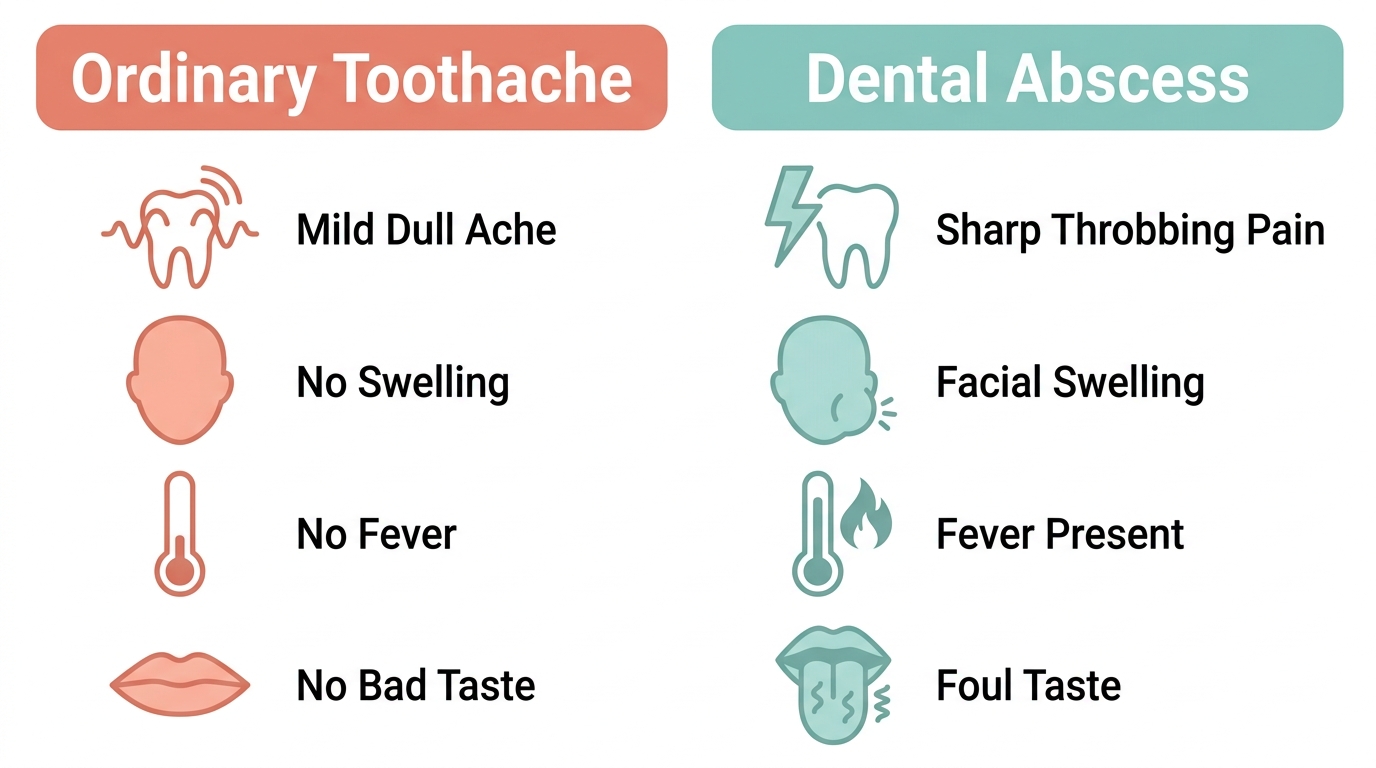
Toothache vs dental abscess symptom comparison chart
A tooth abscess becomes a medical emergency when the infection spreads. As we emphasize in our patient guidance, symptoms like fever (101°F/38.3°C or higher), difficulty breathing or swallowing, swelling spreading to the face or neck, and trouble opening your mouth are dental abscess emergency signs that demand immediate care in New Westminster. Contact Fraser Health emergency services or call our office right away.
We care about your smile and know how distressing a tooth abscess can be. In our judgement free space, we can quickly evaluate your symptoms and guide you. Recognizing the signs early allows you to act fast. If you think you have an abscess, contact our New Westminster clinic — we’re here to help.
The Progression of a Tooth Infection Without Treatment
When bacteria breach the outer enamel, a tooth infection follows a predictable sequence. Recognizing the tooth abscess symptoms and treatment that each stage demands can prevent a minor cavity from escalating into a life-threatening emergency. Here, we walk through the stages of tooth infection to help you understand what’s happening inside your tooth.
| Stage | What Happens | Common Symptoms | Risk Level |
|---|---|---|---|
| Stage 1: Pulpitis | Enamel decay reaches dentin and pulp; bacteria trigger inflammation. | Mild to sharp sensitivity to hot/cold; spontaneous pain. | Low if treated early; moderate if untreated. |
| Stage 2: Periapical Abscess | Pus collects at root tip; bone erosion may occur. | Throbbing pain, swelling, pus drainage, foul taste. | High; local infection with possible fistula. |
| Stage 3: Systemic Infection | Bacteria enter bloodstream; infection spreads to jaw, neck, or other organs. | Fever, difficulty breathing/swallowing, facial swelling. | Critical; requires emergency care. |
The table above summarizes how quickly a simple cavity can worsen. At Diamond Dental Centre, we frequently see patients who delay care, and that’s why we want to highlight each stage in detail.
Stage 1: Enamel Decay and Pulpitis
Pulpitis begins when bacteria in plaque feed on dietary sugars and produce acid that erodes enamel. Once the protective enamel is compromised, the softer dentin layer becomes exposed, allowing irritants to reach the tooth’s inner pulp. At this stage, you may notice a mild twinge when enjoying something sweet or sipping a cold drink. This hypersensitivity, known as reversible pulpitis, generally fades within seconds after the stimulus is removed and indicates that the pulp is still capable of healing if the decay is cleaned and filled promptly.
If the cavity is neglected, the inflammation deepens. Irreversible pulpitis sets in, characterized by sharp, lingering pain—often triggered by hot or cold—that persists even after the trigger is gone. The pain may become spontaneous, waking you up at night. At this point, the pulp tissue is damaged beyond repair. We see many patients in our New Westminster practice who initially dismissed mild sensitivity and then find themselves in need of a root canal. Regular dental exams help catch these early signs before they progress, and we always encourage anyone in the New Westminster area to book an appointment at the first hint of sensitivity. Treating enamel decay early can stop the infection right here, avoiding the more complex and costly interventions that follow.
Stage 2: Formation of Periapical Abscess
As the infection advances unchecked, bacteria travel through the root canal and exit the tiny opening at the root tip. The body responds by sending immune cells to contain the invasion, resulting in a pocket of pus—a periapical abscess. At this point, the hallmark tooth abscess symptoms and treatment requirements become unmistakable. You’ll likely feel constant, throbbing pain that intensifies when you bite down, along with swelling in the gum or cheek. A foul taste may linger in your mouth if the abscess drains through a small pimple on the gum, called a fistula. This drainage can offer deceptive relief, temporarily calming the pain, but the infection is very much alive beneath the surface.
The pressure and swelling can make daily life miserable. While some temporary toothache relief at home measures—such as rinsing with warm salt water—may ease discomfort, as our team’s home care guide describes, they are not a cure. Antibiotics alone cannot eliminate the source; the pus must be drained and the tooth saved through root canal therapy or extracted. We’ve treated many patients who hoped the swelling would disappear, only to have it return more aggressively. Remember, an abscess will not resolve on its own, and delaying treatment risks the spread of infection to surrounding tissues.
Stage 3: Spread of Infection and Systemic Risk
If a periapical abscess is still ignored, the infection can break through the bone and march into the jaw, neck, or facial spaces. This is where dental abscess emergency signs emerge: facial swelling that causes difficulty swallowing or breathing, a fever over 101°F, and a rapid heart rate. In severe cases, bacteria can enter the bloodstream leading to sepsis—a life-threatening condition marked by confusion, chills, and plummeting blood pressure. The infection may even travel to the brain (cavernous sinus thrombosis) or chest (mediastinitis), both of which demand immediate hospital care.
We urge everyone in the Lower Mainland to treat these symptoms as a crisis. At this stage, home care is no longer safe; urgent medical and dental intervention is required. In our experience, few things frighten patients more than realizing a neglected tooth could become a systemic threat. The good news is that even at the cusp of Stage 3, swift treatment—antibiotics combined with drainage and either a root canal or extraction—can still save lives and smiles. Understanding these stages underscores why prompt dental care is essential – in the next section, we explain how each stage is treated.
Immediate Steps and Treatment Options for a Tooth Abscess
When to Seek Emergency Dental Care
When you notice tooth abscess symptoms, it’s important to know what steps to take next. Understanding proper tooth abscess symptoms and treatment is key, but certain dental abscess emergency signs mean you need professional help right away. While there are methods for toothache relief at home, our FAQ explains when these are no longer safe. Here are the most critical warning signs, based on our guidance and Fraser Health recommendations.
- Severe, throbbing pain that keeps you from sleeping or does not respond to over-the-counter pain relievers.
- Facial or gum swelling that spreads to your neck, eye, or across your lower jaw.
- A fever over 101°F (38.3°C) or a general feeling of being unwell.
- Difficulty breathing or swallowing, which may indicate the infection is affecting your airway.
- A sudden foul-tasting discharge in your mouth that signals the abscess has burst.
If you notice any of these red flags, call us or visit the emergency room. Early treatment helps protect your smile. Our team provides judgment-free care.
Root Canal Therapy vs. Extraction
When an abscess develops, the infection reaches the tooth’s pulp. The stage of your tooth infection determines the best treatment. Root canal therapy preserves the natural tooth by removing infected pulp and sealing the canals. Recovery takes only a day or two of minor soreness, ideal for restorable teeth.
For severely damaged teeth, extraction may be necessary. Removing the tooth eliminates the infection and gives a fresh start. Healing typically takes one to two weeks as gum and bone heal. After recovery, we can discuss implant or bridge replacements. Both options are provided at our clinic in New Westminster.
Here is a quick overview:
| Treatment | Procedure | Recovery Time | Best For |
|---|---|---|---|
| Root Canal Therapy | Removes infected pulp; saves tooth | 1–2 days minor soreness | Restorable teeth |
| Tooth Extraction | Removes entire tooth | 1–2 weeks healing | Severely damaged teeth that cannot be saved |
| Antibiotics | Adjunctive medication used with a dental procedure | Temporary infection control only | Temporary control; a dental procedure is required |
Our team will perform a thorough exam and use modern imaging to assess your tooth. Based on the findings, we’ll recommend the best approach. Throughout your care, we treat you with kindness in a judgement-free space.
Role of Antibiotics in Treatment
When you have a dental abscess, antibiotics can play a valuable supporting role. If the infection has spread beyond the tooth or caused swelling, we may prescribe antibiotics to reduce the bacterial load and keep you safe. However, it’s crucial to understand that antibiotics do not treat the root cause of a tooth abscess. The source of the problem—dead or infected pulp tissue and the pus pocket—remains inside the tooth. Only a dental procedure such as root canal therapy or extraction can remove that source and fully resolve the infection.
Our guidance recommends that home management should not exceed one to two days without professional evaluation. Fraser Health also advises that any signs of spreading infection, such as difficulty breathing or swelling crossing the midline, require an emergency room visit. Comprehensive tooth abscess symptoms and treatment planning always involves a hands-on exam. At Diamond Dental Centre, we take a whole-person approach: we eliminate the infection at its source, not just mask symptoms. Once the infection is under control, we’ll discuss the best option to preserve your smile.
When Tooth Extraction Becomes Necessary for a Severe Abscess
An abscessed tooth is a serious dental emergency. Understanding tooth abscess symptoms and treatment helps you recognize when extraction becomes necessary. While we always strive to save your natural tooth with root canal therapy, in some cases the damage is too severe. If you find yourself searching for toothache relief at home, these measures offer only temporary comfort — a severe abscess demands professional evaluation. According to our own guide to managing toothaches, nighttime pain that wakes you up often signals an advanced infection requiring immediate care.
When the tooth’s structure is severely compromised — a large fracture or decay below the gum line — a crown can’t restore it, making extraction necessary. Extraction is also needed if the infection has spread beyond the root apex into the jawbone or a previous root canal has failed. Recognizing dental abscess emergency signs early — swelling, fever, trouble swallowing — is critical because the stages of tooth infection can advance rapidly. Although initial healing after extraction is quicker, you may later need an implant or bridge. At our New Westminster practice, we always educate you about all alternatives, providing both root canal and extraction options.
The following table compares when root canal therapy is preferred versus when extraction becomes the recommended path:
| Factor | Root Canal Preferred | Extraction Preferred |
|---|---|---|
| Tooth structure | Tooth has enough remaining structure to restore | Tooth is fractured or decayed beyond repair |
| Infection extent | Infection is confined to pulp and root canal | Infection has spread to surrounding bone or abscess is large |
| Healing time | Longer recovery (multiple visits, crown later) | Faster initial healing (socket heals in weeks) |
As the table illustrates, root canal is the go-to when the tooth can be saved; extraction is necessary when it cannot. Extraction heals faster initially but typically requires a future implant or bridge. We take time to educate you about these tradeoffs and design a plan that fits your needs.
We care about your smile and your long-term oral health. If extraction turns out to be the best path forward, our team will guide you through a simple, comfortable process and help you plan a replacement soon after. To learn more or schedule an evaluation, call our New Westminster office or book online — we’re here to help.
Common Questions About Tooth Abscesses Answered
Many patients ask about tooth abscess symptoms and treatment; here are clear answers to common questions.
- What are the symptoms of a tooth abscess? Severe toothache, gum or facial swelling, temperature sensitivity, and a bad taste are symptoms. These signs indicate that stages of tooth infection have progressed to an abscess. Prompt care is essential.
- How is a tooth abscess treated? Treatment involves draining the infection and root canal therapy, following Canadian Dental Association guidelines. At Diamond Dental Centre, we offer root canal therapy in a judgement-free space. We care about your smile and your comfort.
- When should I seek emergency dental care for a tooth abscess? We understand dental emergencies can be scary. Seek help for dental abscess emergency signs such as fever, facial swelling, or breathing difficulty. In New Westminster, Diamond Dental Centre offers emergency care in a judgement-free space. Book an appointment online.
Protecting Your Smile: Expert Dental Care in New Westminster
At Diamond Dental Centre in New Westminster, we believe that a healthy smile starts with expert, personalized care. Recognizing early tooth abscess symptoms and treatment options is vital because untreated infections can quickly escalate. We care about your smile and prioritize patient education every step of the way. Our comprehensive guide on toothache relief offers practical advice and highlights dental abscess emergency signs, helping you understand the stages of tooth infection before they require urgent intervention. When you visit our recently upgraded, judgement-free space, you will experience modern technology combined with a friendly, compassionate approach designed to protect your oral health for years to come.