Table of Contents
- Understanding Orthodontic Insurance Coverage in Canada
- Orthodontic Insurance Fundamentals for Canadians
- Comparing Coverage: Invisalign vs Braces Insurance Benefits
- Maximizing Your Orthodontic Benefits: Payment Plans and Financing
- Health Spending Accounts and Advanced Funding for Orthodontics
- Frequently Asked Questions About Orthodontic Coverage
- Your Path to Affordable Orthodontic Treatment
Understanding Orthodontic Insurance Coverage in Canada
When exploring orthodontic insurance coverage Canada, it helps to know the basics first. In Canada, provincial health plans rarely cover orthodontic treatment for adults, which means most families rely on private dental insurance through an employer or individual plan. The Canadian Dental Association notes that many private plans include orthodontic benefits, often with a lifetime maximum and age restrictions that typically limit coverage to dependents under 18. We understand navigating insurance can be confusing—especially when you are trying to plan for the smile you deserve.
Many plans cover both traditional braces and Invisalign, but the percentage covered varies widely. When you’re comparing invisalign vs braces cost canada, the key factor isn’t the type of appliance—it’s how your specific plan defines eligible orthodontic procedures. Always ask your insurer whether Invisalign is included and whether the plan applies the same benefit percentages to both options.
For a broad overview of how coverage works, the Canadian dental insurance orthodontic benefits page from the Canadian Dental Association is an excellent starting point. Beyond that, we encourage you to check your own benefits booklet carefully. A quick checklist can make that conversation with your insurer much easier:
- Find your benefits booklet and look for the orthodontic section.
- Note your yearly maximum and lifetime orthodontic limit.
- Ask if Invisalign and traditional braces are covered equally.
- Bring your insurance information to your next consultation.
At Diamond Dental Centre, we help patients submit claims and provide pre-treatment estimates so you can understand what your plan may contribute. If your coverage is only partial, our team can walk you through Invisalign payment plans in BC without ever disclosing pricing—simply a flexible approach that fits your needs. We care about your smile, and we’ll guide you through the insurance process with a friendly, judgement-free perspective.
Once you know what your plan might cover, the next step is deciding which treatment fits your goals. Our team is here to help you explore the best path forward for a healthy, confident smile.
Orthodontic Insurance Fundamentals for Canadians
Orthodontic insurance coverage Canada can be vastly different from one dental plan to another, making it important for families to understand exactly what their benefits include before beginning treatment. Unlike basic dental insurance, which typically covers preventive and restorative care, orthodontic coverage is often treated as a separate benefit with its own set of rules. This specialized coverage is designed to help offset the cost of treatments that correct tooth and jaw alignment, such as traditional braces and clear aligners like Invisalign.
According to the Canadian Dental Association, orthodontic benefits typically include a distinct lifetime maximum that applies only to orthodontic treatment, rather than an annual limit. This means your plan may set a cap on the total amount it will pay toward braces or aligners over your entire time on that policy. Many plans also impose age limits for dependent coverage, often restricting orthodontic benefits to children under the age of 18 or 19, though some extend coverage to adult dependents when the treatment is deemed medically necessary. Waiting periods are another common feature—some insurers require you to be enrolled in the plan for a set number of months before orthodontic benefits become available, so it is wise to verify this detail early.
It is also important to distinguish between medically necessary orthodontic care and treatment that is primarily cosmetic. Plans are more likely to provide significant orthodontic benefits when the misalignment affects function—such as difficulty chewing, speech challenges, or abnormal wear on teeth—while coverage for purely aesthetic improvements may be minimal or excluded entirely. When you’re weighing your options, such as invisalign vs braces, understanding how your plan classifies each type of treatment can help you budget appropriately and avoid unexpected out-of-pocket expenses.
At Diamond Dental Centre, we make it simple to navigate your dental insurance for orthodontics. Our team will work with you to review your policy, explain your orthodontic benefits, and help you file claims for any covered services. Whether you are considering traditional braces or Invisalign, we take the time to ensure you know exactly what your plan provides, so there are no surprises down the road.
We care about your smile and believe everyone deserves the confidence that comes with a healthy, well-aligned bite. That’s why we encourage you to contact us today to schedule a consultation and verify your orthodontic insurance coverage. For families, our children dentist in New Westminster is specially equipped to guide young patients through orthodontic evaluations and insurance coordination, making the journey as smooth as possible.
Now that you know the basics of orthodontic insurance, let’s look at how to maximize your benefits.
Comparing Coverage: Invisalign vs Braces Insurance Benefits
Beyond the treatment process itself, understanding orthodontic insurance coverage Canada is crucial when deciding between Invisalign and traditional braces. In Canada, both options generally fall under the same orthodontic benefit category, as the Canadian Dental Association notes. However, the details of coverage—especially for adults—vary widely between employer-sponsored policies and individual plans, making it essential to examine your benefits closely.
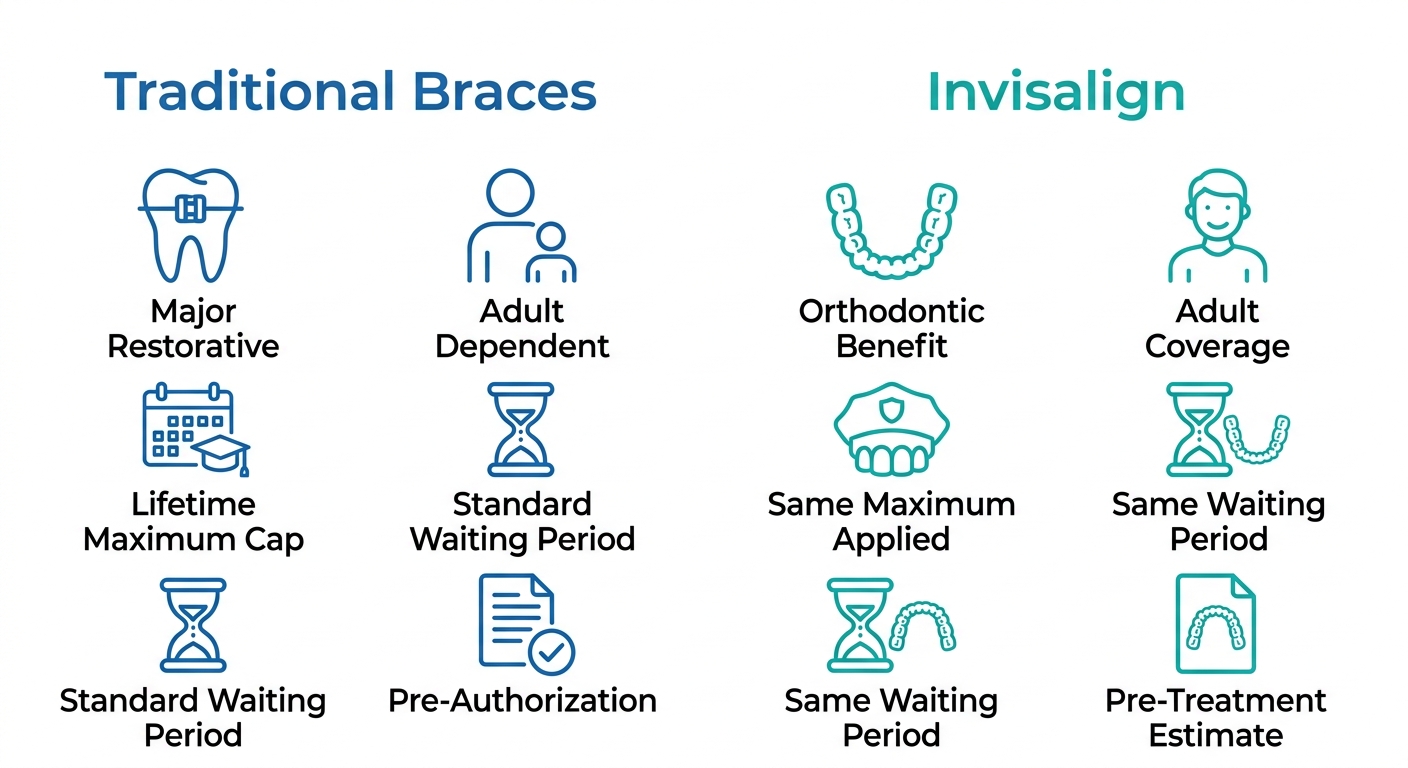
The table below provides a quick overview of how most Canadian plans typically treat the two treatments.
| Insurance Aspect | Traditional Braces | Invisalign |
|---|---|---|
| Insurance Category | Often major restorative or orthodontic | Usually orthodontic (same as braces) |
| Adult Coverage | If policy includes adult ortho | Same as braces; dependent on policy |
| Lifetime Maximum | $1,500–$3,000 typical | Applied same way |
| Waiting Periods | Often 12 months for ortho | Same as braces |
| Pre-treatment Estimate Required | Yes, for most plans | Yes, recommended |
One key takeaway is that lifetime maximums—often between $1,500 and $3,000—apply identically to both Invisalign and braces. You’ll also notice that waiting periods and pre-treatment estimates are standard for orthodontic benefits. The following infographic provides a clear side-by-side comparison to help you visualize these coverage factors.
How Adults Are Covered for Orthodontics
In Canada, adult orthodontic coverage is not guaranteed. Your employer’s group benefits may include a specific orthodontic rider for treatments like braces or Invisalign, but many plans exclude adult orthodontics entirely. The Canadian Dental Association clarifies that adult eligibility is determined by each plan sponsor, so it’s essential to review your policy booklet or speak with your benefits administrator. Even when adult coverage exists, plans typically require a 12-month waiting period and a pre-treatment estimate before you start. We understand that navigating insurance can feel daunting, so we walk every patient through the verification process to ensure clarity. If you are looking for comprehensive orthodontic care, explore our dental clinic services in New Westminster to learn how we can help you navigate your benefits.
Invisalign Cost Breakdown in British Columbia
When patients explore the invisalign vs braces cost Canada comparison, they often begin with the factors that influence the final price of Invisalign in British Columbia. According to Diamond Dental Centre, the Invisalign process varies depending on each person’s alignment needs: the complexity of your case, the number of aligner trays required, and the experience of your provider all play a role. Geographic location within B.C. can also affect pricing, as clinics in larger urban centres may have different overhead costs than those in smaller communities. By understanding these cost drivers, you can better anticipate your investment and explore coverage options that may reduce your out-of-pocket expenses. Many patients find that flexible Invisalign payment plans BC make treatment more affordable; we believe that everyone deserves the smile they love, so we discuss all payment options transparently during your consultation.
Typical Insurance Percentages and Lifetime Maximums
Most Canadian dental insurance plans cover a percentage of orthodontic treatment—commonly around 50%—for both traditional braces and Invisalign, up to a lifetime maximum. As the Canadian Dental Association explains, that maximum is a cumulative dollar limit, not an annual cap, and once you reach it, no further orthodontic benefits are available under the same plan. For many plans, the lifetime maximum falls in the $1,500 to $3,000 range, as shown in the comparison table. This means whether you choose braces or Invisalign, your insurer pays the same percentage, but your total benefit is capped by the same lifetime limit. Because pre-treatment estimates are required, we always submit a detailed treatment plan before you begin, so you have complete financial clarity. This consistency between treatments can ease your decision-making if coverage is your primary concern. Understanding these percentages and limits helps you plan for the portion that insurance won’t cover. Once you know what your insurance covers, exploring payment plans can make Invisalign even more accessible.
Maximizing Your Orthodontic Benefits: Payment Plans and Financing
Now that you know which treatment fits your smile, let’s talk about making it affordable. Orthodontic insurance coverage in Canada varies, but there are several ways to make treatment achievable. At Diamond Dental Centre, we believe everyone deserves a confident smile, so we help you explore every option to combine benefits, payment plans, and other resources.
Invisalign Payment Plans at Diamond Dental Centre
We understand that orthodontic treatment is a significant decision. Invisalign payment plans BC clinics offer, including ours, typically involve a reasonable down payment followed by manageable monthly instalments. When weighing invisalign vs braces cost in Canada, many patients find Invisalign payment plans attractive because they break the investment into predictable pieces. At Diamond Dental Centre, we design these plans with your budget in mind, often featuring 0% financing for a set period so you can start treatment without a large upfront burden. We care about your smile and make the payment process straightforward, explaining every step in a judgement free space where you feel comfortable asking questions. Our team will walk you through the simple application and show you how the payments can align with your monthly finances, letting you focus on the transformation ahead.
Third-Party Dental Financing in BC
If you prefer external financing, several third-party dental financing companies serve British Columbia patients, including iFinance and DentalCard. These providers help bridge the gap when insurance or in-clinic plans aren’t enough. Approval is usually based on a credit check and proof of Canadian residency, and the process is quick, so you can proceed with treatment right away. Terms are competitive, with interest rates that reflect your credit profile, and repayment schedules can extend over several years to keep monthly amounts low. Be aware that interest may accrue if you don’t pay off the balance within a promotional period, so it’s wise to review the agreement carefully. Still, third-party financing gives many of our patients the flexibility they need to afford the smile they want while spreading the cost over time.
Combining Insurance and Health Spending Accounts
Dental insurance in British Columbia often covers a portion of orthodontic treatment, and Health Spending Accounts (HSAs) can fill the remaining gap when used correctly. If your employer offers an HSA, you simply pay the clinic for your portion, then submit the paid receipt to your HSA administrator for reimbursement. Because HSA contributions are made with pre-tax dollars, you save on income tax, which effectively lowers your overall dental expense. It’s important to note that you cannot claim the same expense on both your insurance plan and your HSA; you use your yearly insurance maximum first, then apply HSA funds to the balance. Pre-authorization from your insurer may be required before starting orthodontics, so we recommend checking those requirements early. While orthodontic coverage is common in BC plans, cosmetic procedures like dental bonding may have different rules – learn more about veneers vs bonding cost to understand your options. By stacking these benefits, you can significantly reduce what you pay after insurance and make the treatment more manageable.
The following table summarizes the main financing avenues available for orthodontic treatment in British Columbia:
| Financing Option | Typical Terms | Pros | Cons |
|---|---|---|---|
| In-House Payment Plans | Monthly installments, often up to 24 months | 0% interest possible, integrated with clinic | May require down payment |
| Third-Party Financing (e.g., iFinance, DentalCard) | Up to 60 months, interest rates vary | Flexible approval, quick | Interest accrues if not paid within promo period |
| Health Spending Account (HSA) | Use pre-tax dollars for ortho expenses | Saves on income tax | Requires employer-sponsored HSA |
| Canadian Dental Care Plan (CDCP) | Government contribution based on income | Expands access | Orthodontic coverage may be limited or phased in |
Combining an in-house payment plan with insurance and an HSA often creates the most cost-effective path to a straighter smile. Once you have your financing strategy in place, book a consultation at Diamond Dental Centre to begin your journey. Our team is ready to answer your questions and walk you through every detail in a judgement free space. Book your appointment online today and take the first step toward the smile you deserve.
Health Spending Accounts and Advanced Funding for Orthodontics
Once you’ve chosen the orthodontic approach that best fits your needs, the next step is figuring out how to make it work financially. Health Spending Accounts (HSAs) are a valuable tool for covering orthodontic insurance coverage in Canada. These employer-provided benefits allow you to set aside pre-tax dollars for eligible medical expenses, including treatments that go beyond standard dental plans. The Canadian Dental Association recognizes that orthodontic care, such as Invisalign, is often eligible under HSAs because it is prescribed by a dentist as medically necessary treatment. For residents in British Columbia, this means you may use your HSA to significantly offset the cost of straightening your teeth without relying solely on traditional insurance.
At Diamond Dental Centre, we understand that even with insurance support, the upfront investment in orthodontics can feel daunting. That’s why we offer advanced funding options that are completely separate from your insurance plan. Our Invisalign payment plans in British Columbia are designed to let you begin treatment immediately and spread the cost over time. These arrangements typically come with flexible terms and can be structured without interest, making it easier to fit care into your monthly budget. When comparing invisalign vs braces cost in Canada, many patients find that the ability to pay over time makes orthodontic care far more accessible. We believe everyone deserves a confident smile, and our financing solutions reflect that commitment. We’ll walk you through every option during your complimentary consultation so you leave with a clear picture of what works for you.
The real advantage comes when you pair your HSA with our advanced funding. You can use HSA dollars to cover a portion of treatment while the remainder is managed through a flexible payment schedule. This two-pronged approach often reduces out-of-pocket spending and makes comprehensive orthodontic care achievable without financial strain. During your free assessment, we help map out how these tools work together for your specific situation.
We care about your smile and want to help you access the orthodontic care you deserve. Our team is ready to answer all your questions and build a plan that fits your life and budget. Book your consultation today to explore your HSA and payment options at Diamond Dental Centre.
Frequently Asked Questions About Orthodontic Coverage
Now that you know the options, let’s answer commonly asked questions about navigating your orthodontic coverage.
What does orthodontic insurance cover? Many patients ask about orthodontic insurance coverage Canada. Most plans cover a portion of treatment, and the Canadian Dental Association provides guidelines.
Does my insurance cover Invisalign? Invisalign is increasingly covered; when comparing Invisalign vs braces coverage in Canada, many plans treat both similarly. Always call your insurer to confirm.
How do I check my orthodontic benefits in BC? Bring your insurance card, and we’ll help you understand your Invisalign coverage BC and overall benefits.
How can Diamond Dental Centre help? We provide a judgement-free space where we care about your smile. Bring your insurance card to review benefits, or book a free consultation if you’re still unsure.
Your Path to Affordable Orthodontic Treatment
That’s why we make orthodontic treatment affordable and accessible. When exploring orthodontic insurance coverage in Canada, it’s important to understand your options for Invisalign and braces. At Diamond Dental Centre, we follow Canadian Dental Association standards and help you navigate the Canadian Dental Care Plan and private insurance. You can learn more about CDCP coverage for braces adults from the official government resource. We offer flexible Invisalign payment plans in BC and discuss Invisalign vs braces cost in Canada. Book a consultation to discuss your personalized plan and start your smile transformation. We care about your smile.